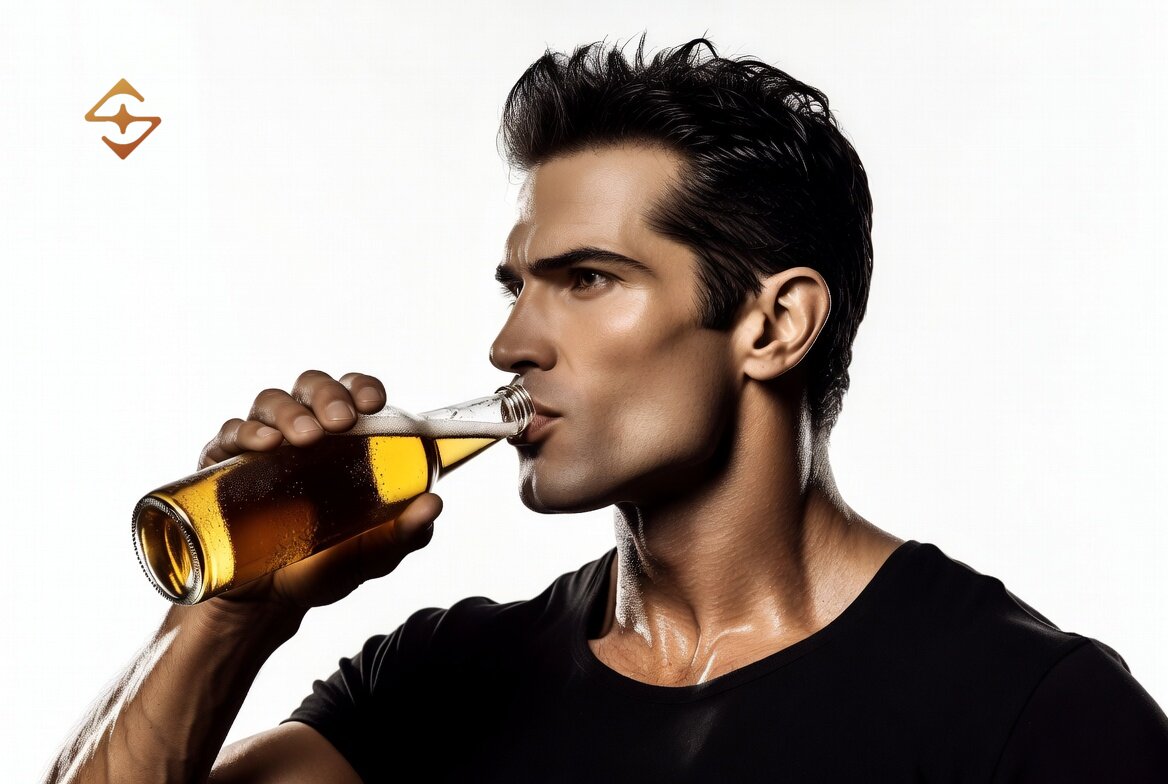
Two guys walk into a bar. Same reading on the scale, 200 pounds each. They match each other drink for drink for three hours. One is a lean, muscular lifter; the other carries his weight soft and around the middle. By last call the muscular one is loose but lucid, and his buddy is slurring. Same weight, same drinks, two completely different nights. The difference comes down mostly to water.
If you’ve ever felt like some people are just built to handle their liquor, you’re not imagining it. Your body composition is one of the biggest dials on how hard alcohol hits you, and muscle and fat pull that dial in opposite directions.
It’s not how much you weigh. It’s what you’re made of.
Alcohol is water-soluble and barely touches fat. Once ethanol is in your bloodstream it spreads through your total body water and effectively ignores fat and bone. So your blood alcohol concentration (BAC) isn’t set by the booze alone: it’s the booze divided by the water it has to spread into.
Think of it as pouring a shot into a glass. Pour it into a pint glass and it’s weak. Pour the same shot into a juice glass and it’s strong. Your total body water is the glass. The more water you carry, the more every drink gets diluted, and the lower your BAC climbs.
Muscle is a sponge. Fat is a raincoat.
Here’s the part that decides who wins at the bar:
- Muscle is about 75% water.
- Fat is roughly 10-20% water, often closer to 10%.
So pound for pound, muscle is a reservoir and fat is nearly dead weight when it comes to diluting alcohol. Take our two 200-pound men: the muscular one might be over 60% water, while the higher-fat one is well under. More water means the exact same drinks land softer.
This isn’t bro-science. Forensic toxicologists nailed it down with the Widmark equation, which boils down to this:
Your BAC ≈ the booze you drank ÷ the water in your body
That water is roughly 68% of a man’s weight and 55% of a woman’s, and it rises with muscle and falls with fat. More water, more dilution, lower BAC. Muscle pushes it up. Fat drags it down.
Yes, being bigger helps, but only the right kind of big
Weight genuinely matters. You’re dividing by your body water, and a bigger person simply carries more of it, so they reach a lower BAC than a smaller person on the same drinks. That’s why a big guy can usually drink a smaller one under the table. Real effect.
But it’s the lean part of that weight doing the work. Fat adds pounds to the scale without adding water to the tank. So between two people who weigh exactly the same, the muscular one always wins, and adding muscle protects you in a way that adding fat never will. Same scale weight, more muscle, lower BAC. Every time.
The myth: muscle doesn’t “burn off” alcohol (mostly)
Worth getting this exactly right, because it’s where most people go wrong. The common belief is that jacked people metabolize alcohol faster. That’s only half true.
The lower BAC is mostly dilution, not faster burning. Around 95-98% of alcohol is cleared by your liver via the enzymes ADH and ALDH, at a roughly fixed rate of about one standard drink per hour, or a BAC drop near 0.015 per hour. That ceiling barely moves. You cannot bench-press your way through it.
But here’s the twist that does favor muscle: a 2024 study found that fat-free mass, not BMI, was the dominant predictor of how fast people eliminated alcohol, explaining (along with age) about 72% of the variation. The reason is mechanical: fat-free mass tracks with lean liver volume, the functional part of the liver that actually does the metabolizing. A bigger working liver clears alcohol faster.
So muscle helps you twice: a lower peak from dilution, and a modestly faster clear from a bigger functional liver. (The clearance study was conducted in women, so treat the elimination effect as suggestive, but the dilution effect is universal physiology.)
Can you sober up or recover faster?
This is what everyone actually wants to know, so here’s the honest answer: in the moment, no. Nothing speeds the liver. Not coffee, not a cold shower, not greasy food, not a sweaty workout. Only time lowers your BAC. “Sweating it out” is a myth.
What your build does change is the recovery math, in two ways:
- You peaked lower. Less alcohol in the tank means there’s less to clear, so you cross back to sober sooner.
- You clear a touch faster. More fat-free mass is linked to a quicker elimination rate.
Less alcohol to begin with plus a bigger liver to process it equals a shorter, milder morning after. And remember a hangover is more than BAC: dehydration, congeners, acetaldehyde, and wrecked sleep all pile on. Water and food won’t sober you up, but they blunt the dehydration and help you feel human. (SpiritFacts offers no medical advice.)
So how do you actually handle alcohol better?
The long game will change your build: Carry more lean muscle. It raises your body water (lower peak) and comes with a bigger functional liver (faster clearance). At the same body weight, a more muscular composition beats a softer one every time. This is the only lever that actually changes your baseline.
The same-night game works no matter your build:
- Eat before and while you drink: food slows absorption and flattens your peak.
- Pace to about one drink per hour: match the rate your liver can clear.
- Alternate with water: it won’t lower BAC, but it fights the dehydration half of a hangover.
- Pick lower-proof, low-congener pours: less alcohol and fewer of the compounds that worsen hangovers.
What doesn’t work: trying to rush sobriety, and confusing tolerance with a lower BAC. Feeling less drunk doesn’t mean you are less drunk. You can be fully impaired and not feel it. A hollow leg is not a clear head.
The bottom line
Your build is a dial on how alcohol hits you, and muscle and fat turn it opposite ways. Muscle is a buff: it’s mostly water, so it dilutes every drink, and it comes with a bigger liver to clear them. Fat is dead weight: it adds pounds without adding the water that protects you. Same weight, more muscle: lower BAC, faster recovery, better night.
But nobody out-muscles the liver’s clock. Build the body, then still pace yourself.
Sources: Widmark factor & blood-ethanol calculation in males and females (PubMed), Body water content of muscle vs. fat (Wikipedia), Body fat, volume of distribution & intoxication (Biology Insights), Alcohol Metabolism (NIAAA), Fat-free mass predicts alcohol elimination rate (PMC 2024). SpiritFacts offers no medical advice.